On Being Less Wrong
What It Means to Be an Educated Person (At Least to Me)


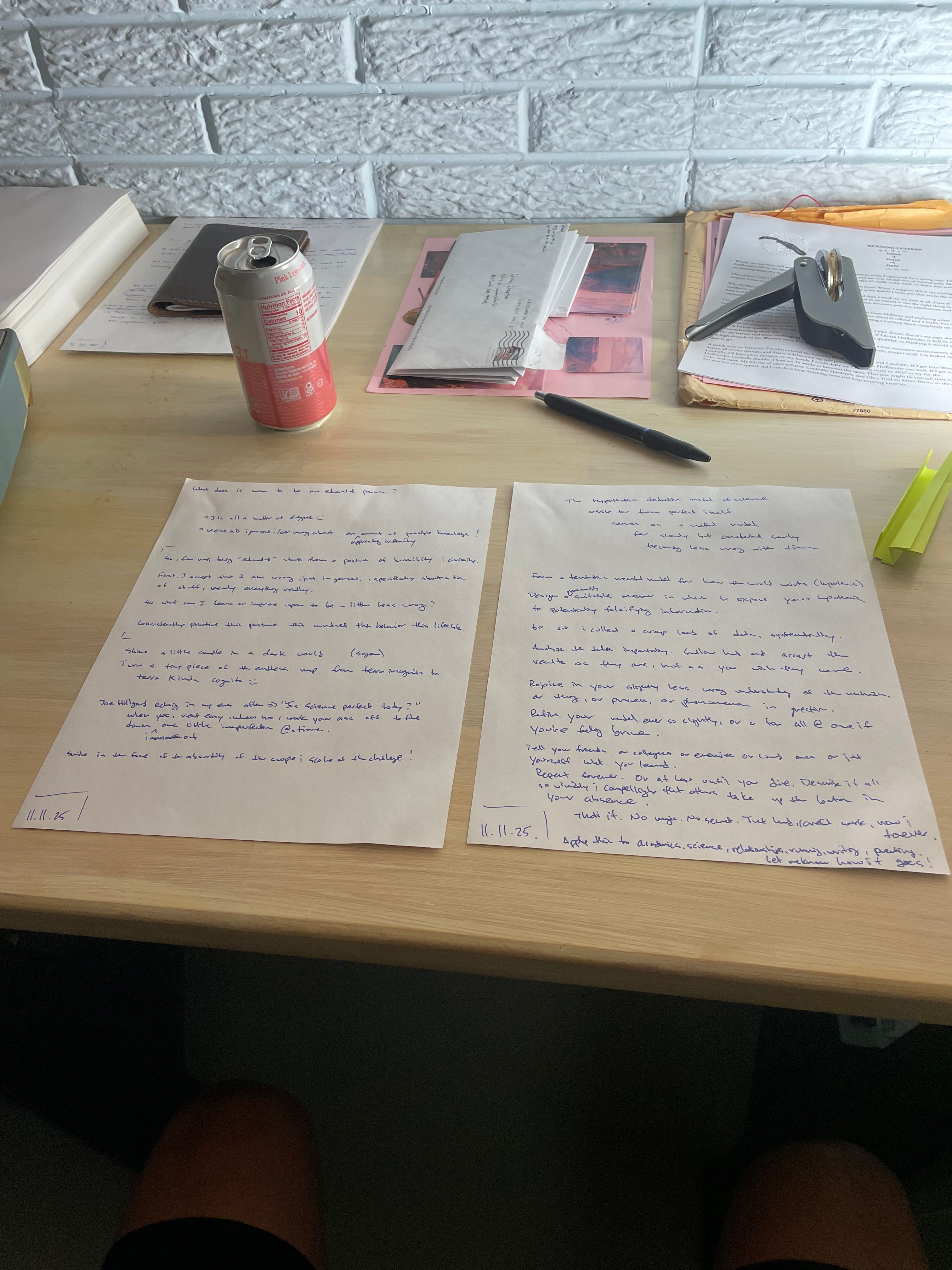
I got invited to speak on a panel for the honors program on campus. Here are my prepared remarks, lightly edited for coherence, clarity, and better flow in the written medium.
The prompt was:
What does it mean to be an educated person?
My honest answer is I don’t know…
…
…
…
(I stared awkwardly at the audience for a while.)
…
…
…but I was invited to be here to speak on the topic, and happily agreed, so a few nights ago, I locked myself in a dank little writing corner of my unfinished basement to figure out what I think. It took me 13 minutes. Here’s what I think it means to be an educated person.
I think it’s all a matter of degree.
We’re all ignorant or wrong about a number of things that approaches the infinitude of all possible knowledge. What any of us knows is hilariously meager.
So for me, being “educated,” or at least moving towards being less uneducated, starts from a posture of humility about how little I know, and curiosity about all the things I could learn.
This is a process, not a status or end state.
First, I try to accept, or even embrace and revel in, the fact that I am wrong, just in general, and specifically about a ton of stuff, nearly everything, really.
Next, I wonder what I can learn or improve upon today to be a little less wrong.
I must consistently practice and remind myself of this posture, this mindset, this way of living.
When I think about my work, the voice of Joe Hilgard from the Society for the Improvement of Psychological Science often echoes in my ears. In a large conference session, he once stood and asked: “Is science perfect today?” When the answer is yes, we can rest easy. Until then, we can work our asses off to file down and smooth over one tiny imperfection at a time.
In this way, we can shine a little candle in a dark world, whether in my own life or in the world more generally. I can turn a tiny piece of the edgeless map from terra incognita into terra-kinda-cognita. Then smile in the face of the absurdity of the scope and scale of the challenge, and look for the next spot to improve a tiny bit.
In practice, the hypothetico-deductive model of science, while of course far from perfect itself, serves as a useful set of rituals for surely slowly, but slowly surely, becoming less wrong with time.
Form a tentative mental model for how the world works. This is a hypothesis.
Design a reasonably suitable or minimally adequate manner by which to expose your hypothesis to potentially falsifying information.
Go out and collect some data, systematically if possible, anecdotally if necessary. Analyze these data impartially. Swallow hard and accept the results as they are, not as you wish they were.
Remember: if your current hypothesis turns out to be wrong, that’s okay. Cross it off the list of possible things to believe, and in either case this little experiment won’t have made much of a difference in your global wrongness level.
Rejoice in your slightly better understanding of the mechanism, or thing, or process, or person, or phenomenon under investigation.
Refine your model ever so slightly, or in a major way all at once if you’re feeling brave.
Tell your friends or colleagues or enemies or loved ones or just yourself what you learned.
Repeat forever. Or at least until you die. Describe and share all of it, the big things and the little things, so vividly and richly and compellingly that others take up the torch and run on ahead into the yawning darkness in your absence.
That’s it. No magic. No secret. Just hard, careful work, now and forever, alone and together.
Apply this to academics, science, relationships, running, writing, parenting, studying, working, resting.
And if you do, let me know what you learn.
I’m still trying to be a little less wrong myself.